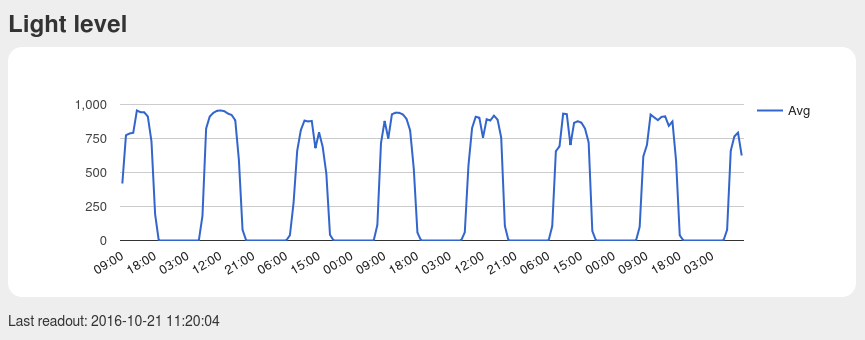
<html> <p>[Pawel] has a weather station, and its nerve-center is a Raspberry Pi. He <a href=„https://quadmeup.com/attiny85-light-sensor-i2c-slave-device/“ target=„_blank“>wanted to include a light sensor</a> but the problem is, the Pi doesn’t have a built-in ADC to read the voltage off the light-dependent resistor that he (presumably) had in his junk box. You can, of course, buy I2C ADC chips and modules, but when you’ve already got a microcontroller that has ADC peripherals on board, why bother?</p> <p>[Pawel] wired up a tremendously simple circuit, downloaded some I2C slave-mode code, and added an LED for good measure. It’s all <a href=„https://github.com/DzikuVx/attiny_photoresistor_i2c“ target=„_blank“>up on GitHub</a> if you’re interested.</p> <figure id=„attachment_228116“ style=„width: 410px“ class=„wp-caption alignright“><a href=„https://hackadaycom.files.wordpress.com/2016/10/cropped_shot_2016-10-21-112958.png“ target=„_blank“><img data-attachment-id=„228116“ data-permalink=„http://hackaday.com/2016/11/07/diy-i2c-devices-with-attiny85/cropped_shot_2016-10-21-112958/“ data-orig-file=„https://hackadaycom.files.wordpress.com/2016/10/cropped_shot_2016-10-21-112958.png“ data-orig-size=„865,340“ data-comments-opened=„1“ data-image-meta=„{"aperture":"0","credit":"","camera":"","caption":"","created_timestamp":"0","copyright":"","focal_length":"0","iso":"0","shutter_speed":"0","title":"","orientation":"0"}“ data-image-title=„cropped_shot_2016-10-21-112958“ data-image-description=„“ data-medium-file=„https://hackadaycom.files.wordpress.com/2016/10/cropped_shot_2016-10-21-112958.png?w=400&h=157“ data-large-file=„https://hackadaycom.files.wordpress.com/2016/10/cropped_shot_2016-10-21-112958.png?w=800“ class=„wp-image-228116 size-medium“ src=„https://hackadaycom.files.wordpress.com/2016/10/cropped_shot_2016-10-21-112958.png?w=400&h=157“ alt=„cropped_shot_2016-10-21-112958“ width=„400“ height=„157“ srcset=„https://hackadaycom.files.wordpress.com/2016/10/cropped_shot_2016-10-21-112958.png?w=400&h=157 400w, https://hackadaycom.files.wordpress.com/2016/10/cropped_shot_2016-10-21-112958.png?w=800&h=314 800w, https://hackadaycom.files.wordpress.com/2016/10/cropped_shot_2016-10-21-112958.png?w=250&h=98 250w, https://hackadaycom.files.wordpress.com/2016/10/cropped_shot_2016-10-21-112958.png?w=768&h=302 768w“ sizes=„(max-width: 400px) 100vw, 400px“/></a><figcaption class=„wp-caption-text“>Bright by Day, Dark by Night!</figcaption></figure><p>We’re covering this because we rarely see people coding for I2C slave devices. Everyone and their mom <em>uses</em> I2C to connect to sensors, for which the Arduino “Wire” library or “i2c-tools” on the Pi do just fine. But what do you do when you want to <em>make</em> the I2C device? [Pawel]’s project makes use of <a href=„https://github.com/rambo/TinyWire/tree/master/TinyWireS“ target=„_blank“>TinyWireS</a>, a slave-mode SPI and I2C library for AVR ATtiny Arduino projects.</p> <p>Here, [Pawel] just wanted a light sensor. But if you’re building your own devices, the sky is the limit. What’s the most esoteric I2C sensor that you can imagine? (And is it really the case that we haven’t seen an I2C slave device hack <a href=„http://hackaday.com/2010/08/06/make-your-own-mindstorm-sensors/“>since 2010</a>?)</p> </html>