Nile shipwreck discovery proves Herodotus right – after 2,469 years
<html> <meta itemprop=„mainEntityOfPage“ content=„https://www.theguardian.com/science/2019/mar/17/nile-shipwreck-herodotus-archaeologists-thonis-heraclion“/><div itemprop=„publisher“ itemscope=„“ itemtype=„https://schema.org/Organization“> <meta itemprop=„name“ content=„The Guardian“/><div itemprop=„logo“ itemscope=„“ itemtype=„https://schema.org/ImageObject“> <meta itemprop=„url“ content=„https://uploads.guim.co.uk/2018/01/31/TheGuardian_AMP.png“/><meta itemprop=„width“ content=„190“/><meta itemprop=„height“ content=„60“/></div> <link itemprop=„sameAs“ href=„https://www.theguardian.com“/></div><div class=„contentmain tonalmain tonalmain–tone-news“> <div class=„gs-container“> <div class=„contentmain-column contentmain-column–article js-content-main-column “> <header class=„contenthead contenthead–article tonalhead tonalhead–tone-news“><div class=„matchreport“> <div class=„js-score“/> <div class=„js-sport-tabs football-tabs“/> </div> <div class=„contentlabels contentlabels–not-immersive “> <div class=„contentseries-label contentlabel“> <a class=„contentlabellink“ href=„https://www.theguardian.com/observer“>The Observer</a> </div> <div class=„contentsection-label contentlabel“> <a class=„contentlabellink“ data-link-name=„article section“ href=„https://www.theguardian.com/science/archaeology“> Archaeology </a> </div> </div> <div class=„contentheadline-standfirst-wrapper“> <div class=„contentheader tonalheader“> <div class=„u-cf“>

</div> </div> <div class=„tonalstandfirst u-cf“> <div class=„contentstandfirst“ data-link-name=„standfirst“ data-component=„standfirst“> <meta itemprop=„description“ content=„Greek historian’s description of ‘baris’ vessel vindicated by archaeologists at sunken city of Thonis-Heraclion“/><p>Greek historian’s description of ‘baris’ vessel vindicated by archaeologists at sunken city of Thonis-Heraclion</p> </div> </div> </div>
<figure itemprop=„associatedMedia image“ itemscope=„“ itemtype=„http://schema.org/ImageObject“ data-component=„image“ class=„media-primary media-content () “ data-media-id=„9522c358b4bb4c154bedec572676a3d231dffef6“ id=„img-1“><meta itemprop=„representativeOfPage“ content=„true“/><meta itemprop=„url“ content=„https://i.guim.co.uk/img/media/9522c358b4bb4c154bedec572676a3d231dffef6/0_228_7113_4267/master/7113.jpg?width=700&quality=85&auto=format&fit=max&s=c8652c45a4138211cbe7dd6975a15203“/><meta itemprop=„width“ content=„7113“/><meta itemprop=„height“ content=„4267“/><a href=„https://www.theguardian.com/science/2019/mar/17/nile-shipwreck-herodotus-archaeologists-thonis-heraclion#img-1“ class=„articleimg-container js-gallerythumbs“ data-link-name=„Launch Article Lightbox“ data-is-ajax=„“> <div class=„u-responsive-ratio“ style=„padding-bottom: 59.99%“> <picture><!–[if IE 9]><video style=„display: none;“><![endif]–><source media=„(min-width: 980px) and (-webkit-min-device-pixel-ratio: 1.25), (min-width: 980px) and (min-resolution: 120dpi)“ sizes=„620px“ srcset=„https://i.guim.co.uk/img/media/9522c358b4bb4c154bedec572676a3d231dffef6/0_228_7113_4267/master/7113.jpg?width=620&quality=45&auto=format&fit=max&dpr=2&s=e9d7f6a128de0a19a7a503633289f8c2 1240w“/><source media=„(min-width: 980px)“ sizes=„620px“ srcset=„https://i.guim.co.uk/img/media/9522c358b4bb4c154bedec572676a3d231dffef6/0_228_7113_4267/master/7113.jpg?width=620&quality=85&auto=format&fit=max&s=bb0318ac7e9b270fc77c51041d3f526e 620w“/><source media=„(min-width: 740px) and (-webkit-min-device-pixel-ratio: 1.25), (min-width: 740px) and (min-resolution: 120dpi)“ sizes=„700px“ srcset=„https://i.guim.co.uk/img/media/9522c358b4bb4c154bedec572676a3d231dffef6/0_228_7113_4267/master/7113.jpg?width=700&quality=45&auto=format&fit=max&dpr=2&s=f94b6ddd9117dd4d5d9749c5dbfa436c 1400w“/><source media=„(min-width: 740px)“ sizes=„700px“ srcset=„https://i.guim.co.uk/img/media/9522c358b4bb4c154bedec572676a3d231dffef6/0_228_7113_4267/master/7113.jpg?width=700&quality=85&auto=format&fit=max&s=c8652c45a4138211cbe7dd6975a15203 700w“/><source media=„(min-width: 660px) and (-webkit-min-device-pixel-ratio: 1.25), (min-width: 660px) and (min-resolution: 120dpi)“ sizes=„620px“ srcset=„https://i.guim.co.uk/img/media/9522c358b4bb4c154bedec572676a3d231dffef6/0_228_7113_4267/master/7113.jpg?width=620&quality=45&auto=format&fit=max&dpr=2&s=e9d7f6a128de0a19a7a503633289f8c2 1240w“/><source media=„(min-width: 660px)“ sizes=„620px“ srcset=„https://i.guim.co.uk/img/media/9522c358b4bb4c154bedec572676a3d231dffef6/0_228_7113_4267/master/7113.jpg?width=620&quality=85&auto=format&fit=max&s=bb0318ac7e9b270fc77c51041d3f526e 620w“/><source media=„(min-width: 480px) and (-webkit-min-device-pixel-ratio: 1.25), (min-width: 480px) and (min-resolution: 120dpi)“ sizes=„645px“ srcset=„https://i.guim.co.uk/img/media/9522c358b4bb4c154bedec572676a3d231dffef6/0_228_7113_4267/master/7113.jpg?width=645&quality=45&auto=format&fit=max&dpr=2&s=6af5c308fae70199daef36822e95a093 1290w“/><source media=„(min-width: 480px)“ sizes=„645px“ srcset=„https://i.guim.co.uk/img/media/9522c358b4bb4c154bedec572676a3d231dffef6/0_228_7113_4267/master/7113.jpg?width=645&quality=85&auto=format&fit=max&s=364b86ab11306831658f4a43257474df 645w“/><source media=„(min-width: 0px) and (-webkit-min-device-pixel-ratio: 1.25), (min-width: 0px) and (min-resolution: 120dpi)“ sizes=„465px“ srcset=„https://i.guim.co.uk/img/media/9522c358b4bb4c154bedec572676a3d231dffef6/0_228_7113_4267/master/7113.jpg?width=465&quality=45&auto=format&fit=max&dpr=2&s=9bda4f48cd73bc799496ec8f89fc6570 930w“/><source media=„(min-width: 0px)“ sizes=„465px“ srcset=„https://i.guim.co.uk/img/media/9522c358b4bb4c154bedec572676a3d231dffef6/0_228_7113_4267/master/7113.jpg?width=465&quality=85&auto=format&fit=max&s=3dd559ffab475f79df3eb8b204f7d450 465w“/><!–[if IE 9]></video><![endif]–><img class=„maxed responsive-img“ itemprop=„contentUrl“ alt=„An archaeologist inspects the keel of a shipwreck discovered in the waters around the sunken port-city of Thonis-Heracleion.“ src=„https://i.guim.co.uk/img/media/9522c358b4bb4c154bedec572676a3d231dffef6/0_228_7113_4267/master/7113.jpg?width=300&quality=85&auto=format&fit=max&s=15f4bd62f59e66c04b2a0aee22a5e879“/></picture></div> <svg width=„22“ height=„22“ viewbox=„0 0 22 22“ class=„centered-iconsvg rounded-iconsvg articlefullscreensvg modern-visiblesvg inline-expand-imagesvg inline-iconsvg“><path d=„M3.4 20.2L9 14.5 7.5 13l-5.7 5.6L1 14H0v7.5l.5.5H8v-1l-4.6-.8M18.7 1.9L13 7.6 14.4 9l5.7-5.7.5 4.7h1.2V.6l-.5-.5H14v1.2l4.7.6“/></svg></a> <input type=„checkbox“ id=„show-caption“ class=„mobile-only u-h reveal-captioncheckbox“/><label class=„mobile-only reveal-caption reveal-caption–img“ for=„show-caption“> <svg width=„6“ height=„14“ viewbox=„0 0 6 14“ class=„reveal-caption-iconsvg centered-iconsvg inline-informationsvg inline-iconsvg“><path d=„M4.6 12l-.4 1.4c-.7.2-1.9.6-3 .6-.7 0-1.2-.2-1.2-.9 0-.2 0-.3.1-.5l2-6.7H.7l.4-1.5 4.2-.6h.2L3 12h1.6zm-.3-9.2c-.9 0-1.4-.5-1.4-1.3C2.9.5 3.7 0 4.6 0 5.4 0 6 .5 6 1.3c0 1-.8 1.5-1.7 1.5z“/></svg></label> <figcaption class=„caption caption–main caption–img“ itemprop=„description“><svg width=„11“ height=„10“ viewbox=„0 0 11 10“ class=„hide-until-tabletsvg inline-trianglesvg inline-iconsvg“><path fill-rule=„evenodd“ d=„M5.5 0L11 10H0z“/></svg>


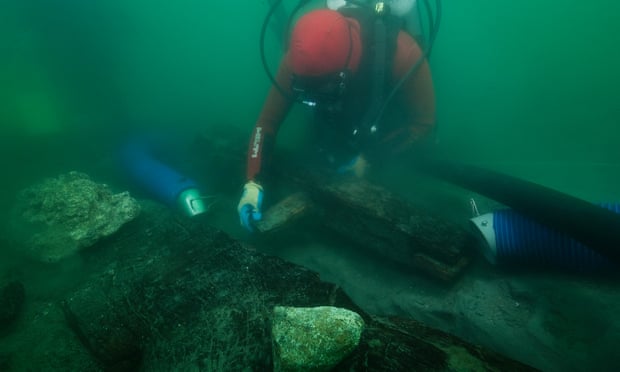


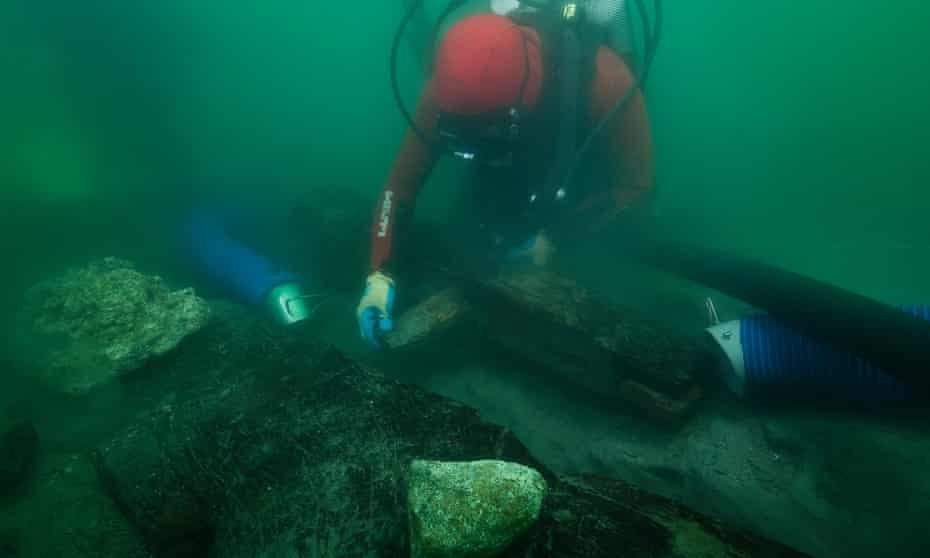

An archaeologist inspects the keel of a shipwreck discovered in the waters around the sunken port-city of Thonis-Heracleion. Photograph: Christoph Gerigk/Franck Goddio/Hilti Foundation </figcaption></figure></header><div class=„contentarticle-body from-content-api js-articlebody“ itemprop=„articleBody“ data-test-id=„article-review-body“> <p>In the fifth century BC, the Greek historian Herodotus visited <a href=„https://www.theguardian.com/world/egypt“ data-link-name=„auto-linked-tag“ data-component=„auto-linked-tag“ class=„u-underline“>Egypt</a> and wrote of unusual river boats on the Nile. Twenty-three lines of his <em>Historia</em>, the ancient world’s first great narrative history, are devoted to the intricate description of the construction of a “baris”.</p> <p>For centuries, scholars have argued over his account because there was no archaeological evidence that such ships ever existed. Now there is. A “fabulously preserved” wreck in the waters around the <a href=„https://www.theguardian.com/cities/2016/aug/15/lost-cities-6-thonis-heracleion-egypt-sunken-sea“ title=„“ data-link-name=„in body link“ class=„u-underline“>sunken port city of Thonis-Heracleion</a> has revealed just how accurate the historian was.</p> <p>“It wasn’t until we discovered this wreck that we realised Herodotus was right,” said Dr Damian Robinson, director of <a href=„http://projects.arch.ox.ac.uk/ocma.html“ data-link-name=„in body link“ class=„u-underline“>Oxford University’s centre for maritime archaeology</a>, which is publishing the excavation’s findings. “What Herodotus described was what we were looking at.”</p> <figure itemprop=„associatedMedia image“ itemscope=„“ itemtype=„http://schema.org/ImageObject“ data-component=„image“ class=„element element-image img–landscape fig–narrow-caption fig–has-shares “ data-media-id=„8c94b1d224fb6a40da23599aa9da78291544e576“ id=„img-2“><meta itemprop=„url“ content=„https://i.guim.co.uk/img/media/8c94b1d224fb6a40da23599aa9da78291544e576/151_0_1520_912/master/1520.jpg?width=700&quality=85&auto=format&fit=max&s=0029926bd4bd428efcd80527365539f1“/><meta itemprop=„width“ content=„1520“/><meta itemprop=„height“ content=„912“/><a href=„https://www.theguardian.com/science/2019/mar/17/nile-shipwreck-herodotus-archaeologists-thonis-heraclion#img-2“ class=„articleimg-container js-gallerythumbs“ data-link-name=„Launch Article Lightbox“ data-is-ajax=„“> <div class=„u-responsive-ratio“ style=„padding-bottom: 60.00%“> <picture><!–[if IE 9]><video style=„display: none;“><![endif]–><source media=„(min-width: 660px) and (-webkit-min-device-pixel-ratio: 1.25), (min-width: 660px) and (min-resolution: 120dpi)“ sizes=„620px“ srcset=„https://i.guim.co.uk/img/media/8c94b1d224fb6a40da23599aa9da78291544e576/151_0_1520_912/master/1520.jpg?width=620&quality=45&auto=format&fit=max&dpr=2&s=ac96dbb57e2a7388c7222f3c470776c7 1240w“><source media=„(min-width: 660px)“ sizes=„620px“ srcset=„https://i.guim.co.uk/img/media/8c94b1d224fb6a40da23599aa9da78291544e576/151_0_1520_912/master/1520.jpg?width=620&quality=85&auto=format&fit=max&s=435187fc37b4fa6ee84eba34cbdf963b 620w“><source media=„(min-width: 480px) and (-webkit-min-device-pixel-ratio: 1.25), (min-width: 480px) and (min-resolution: 120dpi)“ sizes=„605px“ srcset=„https://i.guim.co.uk/img/media/8c94b1d224fb6a40da23599aa9da78291544e576/151_0_1520_912/master/1520.jpg?width=605&quality=45&auto=format&fit=max&dpr=2&s=9cdf28a4a323da33a86855d4a129e959 1210w“><source media=„(min-width: 480px)“ sizes=„605px“ srcset=„https://i.guim.co.uk/img/media/8c94b1d224fb6a40da23599aa9da78291544e576/151_0_1520_912/master/1520.jpg?width=605&quality=85&auto=format&fit=max&s=caea8fa475a7b7858808c2a20c462b61 605w“><source media=„(min-width: 0px) and (-webkit-min-device-pixel-ratio: 1.25), (min-width: 0px) and (min-resolution: 120dpi)“ sizes=„445px“ srcset=„https://i.guim.co.uk/img/media/8c94b1d224fb6a40da23599aa9da78291544e576/151_0_1520_912/master/1520.jpg?width=445&quality=45&auto=format&fit=max&dpr=2&s=a1ddfef94d678f9c80c755fd6817c79e 890w“><source media=„(min-width: 0px)“ sizes=„445px“ srcset=„https://i.guim.co.uk/img/media/8c94b1d224fb6a40da23599aa9da78291544e576/151_0_1520_912/master/1520.jpg?width=445&quality=85&auto=format&fit=max&s=7e020cbaa4cb265afad64d0511219d51 445w“><!–[if IE 9]></video><![endif]–><img class=„gu-image“ itemprop=„contentUrl“ alt=„An artistic treatment of the discovered shipwreck“ src=„https://i.guim.co.uk/img/media/8c94b1d224fb6a40da23599aa9da78291544e576/151_0_1520_912/master/1520.jpg?width=300&quality=85&auto=format&fit=max&s=38e156d06cb78de5c755360944a3093c“/></source></source></source></source></source></source></picture></div> <svg width=„22“ height=„22“ viewbox=„0 0 22 22“ class=„centered-iconsvg rounded-iconsvg articlefullscreensvg modern-visiblesvg inline-expand-imagesvg inline-iconsvg“><path d=„M3.4 20.2L9 14.5 7.5 13l-5.7 5.6L1 14H0v7.5l.5.5H8v-1l-4.6-.8M18.7 1.9L13 7.6 14.4 9l5.7-5.7.5 4.7h1.2V.6l-.5-.5H14v1.2l4.7.6“/></svg></a>
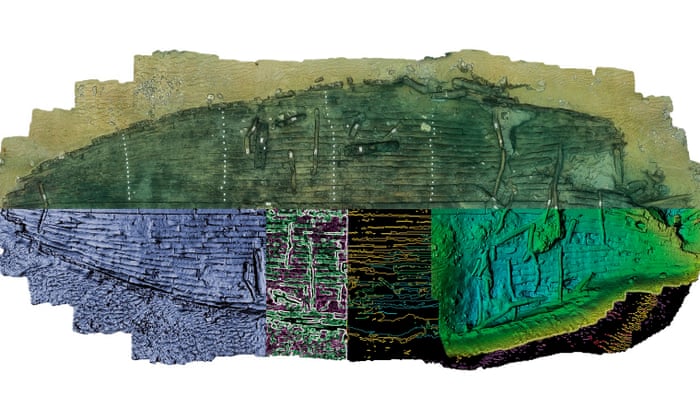

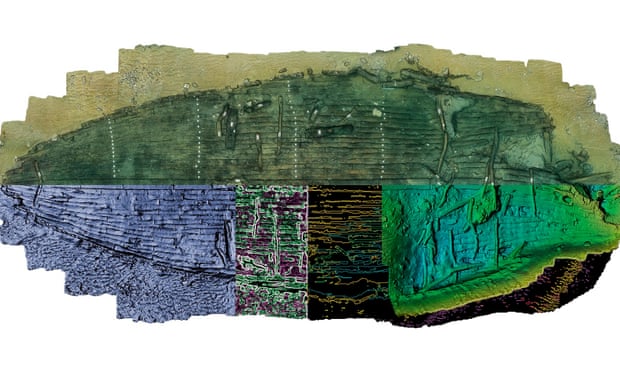


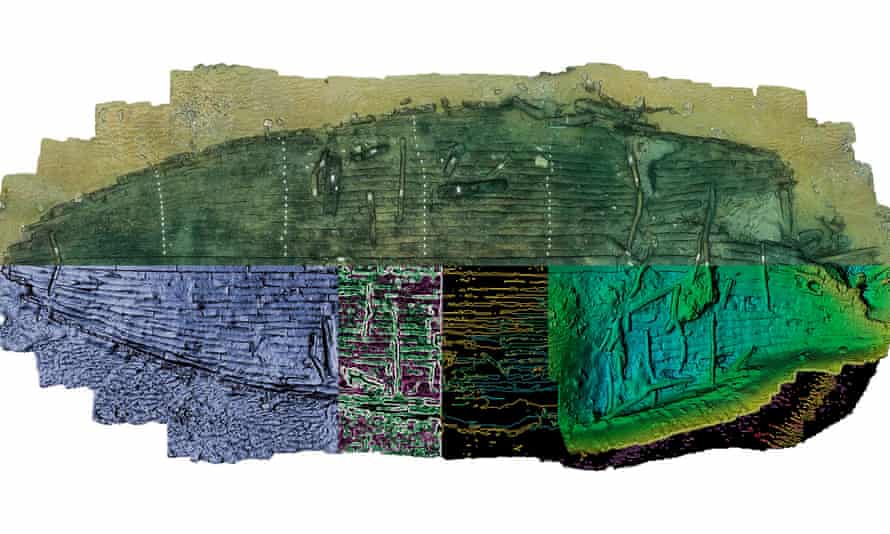

<figcaption class=„caption caption–img caption caption–img“ itemprop=„description“><svg width=„11“ height=„10“ viewbox=„0 0 11 10“ class=„inline-trianglesvg inline-iconsvg“><path fill-rule=„evenodd“ d=„M5.5 0L11 10H0z“/></svg> An artistic treatment of the discovered shipwreck. The upper half of the model illustrates the wreck as excavated. Below this, unexcavated areas are mirrored to pro­duce a complete vessel outline. Photograph: Christoph Gerigk/Franck Goddio/Hilti Foundation </figcaption></figure><p>In 450 BC Herodotus witnessed the construction of a baris. He noted how the builders “cut planks two cubits long [around 100cm] and arrange them like bricks”. He added: “On the strong and long tenons [pieces of wood] they insert two-cubit planks. When they have built their ship in this way, they stretch beams over them… They obturate the seams from within with papyrus. There is one rudder, passing through a hole in the keel. The mast is of acacia and the sails of papyrus…”</p> <p>Robinson said that previous scholars had “made some mistakes” in struggling to interpret the text without archaeological evidence. “It’s one of those enigmatic pieces. Scholars have argued exactly what it means for as long as we’ve been thinking of boats in this scholarly way,” he said.</p> <figure itemprop=„associatedMedia image“ itemscope=„“ itemtype=„http://schema.org/ImageObject“ data-component=„image“ class=„element element-image img–portrait fig–narrow-caption fig–has-shares “ data-media-id=„49c824a54e05d39eaa84880ea46748be41eae79e“ id=„img-3“><meta itemprop=„url“ content=„https://i.guim.co.uk/img/media/49c824a54e05d39eaa84880ea46748be41eae79e/62_292_2351_2937/master/2351.jpg?width=700&quality=85&auto=format&fit=max&s=d4a146aefb37e30354f3246e2755be61“/><meta itemprop=„width“ content=„2351“/><meta itemprop=„height“ content=„2937“/><a href=„https://www.theguardian.com/science/2019/mar/17/nile-shipwreck-herodotus-archaeologists-thonis-heraclion#img-3“ class=„articleimg-container js-gallerythumbs“ data-link-name=„Launch Article Lightbox“ data-is-ajax=„“> <div class=„u-responsive-ratio“ style=„padding-bottom: 124.93%“> <picture><!–[if IE 9]><video style=„display: none;“><![endif]–><source media=„(min-width: 660px) and (-webkit-min-device-pixel-ratio: 1.25), (min-width: 660px) and (min-resolution: 120dpi)“ sizes=„620px“ srcset=„https://i.guim.co.uk/img/media/49c824a54e05d39eaa84880ea46748be41eae79e/62_292_2351_2937/master/2351.jpg?width=620&quality=45&auto=format&fit=max&dpr=2&s=3c1a715bf29ccd25e924fb1dc0dc95c9 1240w“><source media=„(min-width: 660px)“ sizes=„620px“ srcset=„https://i.guim.co.uk/img/media/49c824a54e05d39eaa84880ea46748be41eae79e/62_292_2351_2937/master/2351.jpg?width=620&quality=85&auto=format&fit=max&s=ba0df3e06ed29d79157480fc762d2c06 620w“><source media=„(min-width: 480px) and (-webkit-min-device-pixel-ratio: 1.25), (min-width: 480px) and (min-resolution: 120dpi)“ sizes=„605px“ srcset=„https://i.guim.co.uk/img/media/49c824a54e05d39eaa84880ea46748be41eae79e/62_292_2351_2937/master/2351.jpg?width=605&quality=45&auto=format&fit=max&dpr=2&s=020e1ca82f04da2c71994e4381629cc3 1210w“><source media=„(min-width: 480px)“ sizes=„605px“ srcset=„https://i.guim.co.uk/img/media/49c824a54e05d39eaa84880ea46748be41eae79e/62_292_2351_2937/master/2351.jpg?width=605&quality=85&auto=format&fit=max&s=c982761d7c1c290ae96dc8d60673833b 605w“><source media=„(min-width: 0px) and (-webkit-min-device-pixel-ratio: 1.25), (min-width: 0px) and (min-resolution: 120dpi)“ sizes=„445px“ srcset=„https://i.guim.co.uk/img/media/49c824a54e05d39eaa84880ea46748be41eae79e/62_292_2351_2937/master/2351.jpg?width=445&quality=45&auto=format&fit=max&dpr=2&s=d83f437228748c69c244c53484b15340 890w“><source media=„(min-width: 0px)“ sizes=„445px“ srcset=„https://i.guim.co.uk/img/media/49c824a54e05d39eaa84880ea46748be41eae79e/62_292_2351_2937/master/2351.jpg?width=445&quality=85&auto=format&fit=max&s=37d17e04dfc6924947e5457eee703798 445w“><!–[if IE 9]></video><![endif]–><img class=„gu-image“ itemprop=„contentUrl“ alt=„Bust of Herodotus“ src=„https://i.guim.co.uk/img/media/49c824a54e05d39eaa84880ea46748be41eae79e/62_292_2351_2937/master/2351.jpg?width=300&quality=85&auto=format&fit=max&s=336af3d57b63f685aa941454d948708f“/></source></source></source></source></source></source></picture></div> <svg width=„22“ height=„22“ viewbox=„0 0 22 22“ class=„centered-iconsvg rounded-iconsvg articlefullscreensvg modern-visiblesvg inline-expand-imagesvg inline-iconsvg“><path d=„M3.4 20.2L9 14.5 7.5 13l-5.7 5.6L1 14H0v7.5l.5.5H8v-1l-4.6-.8M18.7 1.9L13 7.6 14.4 9l5.7-5.7.5 4.7h1.2V.6l-.5-.5H14v1.2l4.7.6“/></svg></a>
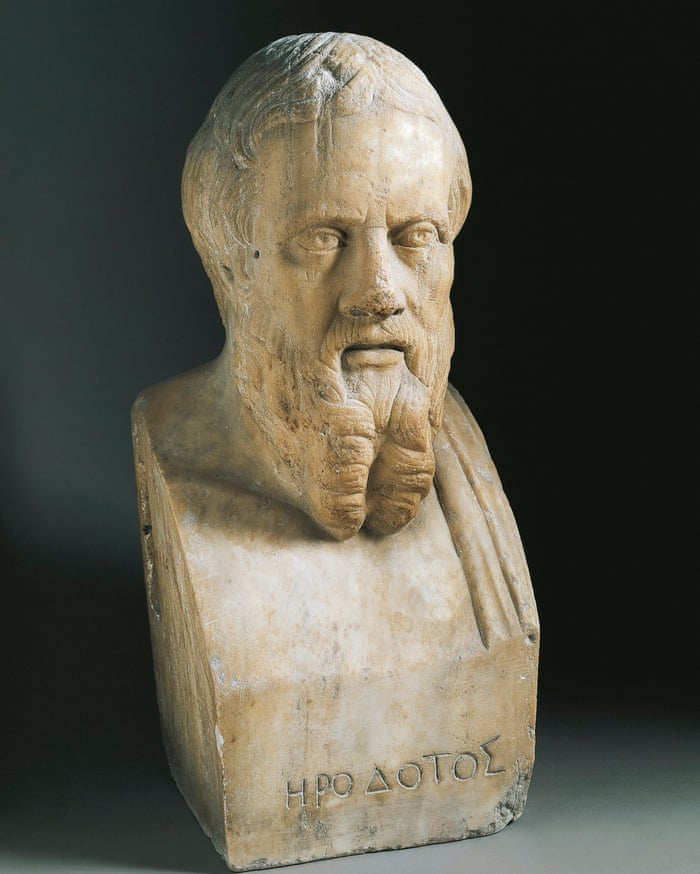


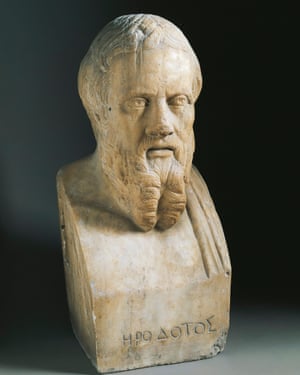
<figcaption class=„caption caption–img caption caption–img“ itemprop=„description“><svg width=„11“ height=„10“ viewbox=„0 0 11 10“ class=„inline-trianglesvg inline-iconsvg“><path fill-rule=„evenodd“ d=„M5.5 0L11 10H0z“/></svg> Bust of Herodotus of Halicarnassus (c484-425 BC) Photograph: G Nimatallah/De Agostini/Getty Images </figcaption></figure><p>But the excavation of what has been called Ship 17 has revealed a vast crescent-shaped hull and a previously undocumented type of construction involving thick planks assembled with tenons – just as Herodotus observed, in describing a slightly smaller vessel.</p> <p>Originally measuring up to 28 metres long, it is one of the first large-scale ancient Egyptian trading boats ever to have been discovered.</p> <p>Robinson added: “Herodotus describes the boats as having long internal ribs. Nobody really knew what that meant… That structure’s never been seen archaeologically before. Then we discovered this form of construction on this particular boat and it absolutely is what Herodotus has been saying.”</p> <figure itemprop=„associatedMedia image“ itemscope=„“ itemtype=„http://schema.org/ImageObject“ data-component=„image“ class=„element element-image img–landscape fig–narrow-caption fig–has-shares “ data-media-id=„54272aa61d713677be76f6304cb86f3e6c7b0f4c“ id=„img-4“><meta itemprop=„url“ content=„https://i.guim.co.uk/img/media/54272aa61d713677be76f6304cb86f3e6c7b0f4c/0_370_7087_4252/master/7087.jpg?width=700&quality=85&auto=format&fit=max&s=768494a2308477c1986c13edf34a3716“/><meta itemprop=„width“ content=„7087“/><meta itemprop=„height“ content=„4252“/><a href=„https://www.theguardian.com/science/2019/mar/17/nile-shipwreck-herodotus-archaeologists-thonis-heraclion#img-4“ class=„articleimg-container js-gallerythumbs“ data-link-name=„Launch Article Lightbox“ data-is-ajax=„“> <div class=„u-responsive-ratio“ style=„padding-bottom: 60.00%“> <picture><!–[if IE 9]><video style=„display: none;“><![endif]–><source media=„(min-width: 660px) and (-webkit-min-device-pixel-ratio: 1.25), (min-width: 660px) and (min-resolution: 120dpi)“ sizes=„620px“ srcset=„https://i.guim.co.uk/img/media/54272aa61d713677be76f6304cb86f3e6c7b0f4c/0_370_7087_4252/master/7087.jpg?width=620&quality=45&auto=format&fit=max&dpr=2&s=c83ec4bf27a4299ed6dd4438f88b308c 1240w“><source media=„(min-width: 660px)“ sizes=„620px“ srcset=„https://i.guim.co.uk/img/media/54272aa61d713677be76f6304cb86f3e6c7b0f4c/0_370_7087_4252/master/7087.jpg?width=620&quality=85&auto=format&fit=max&s=e21e50731c8c0046145bced48a74dc19 620w“><source media=„(min-width: 480px) and (-webkit-min-device-pixel-ratio: 1.25), (min-width: 480px) and (min-resolution: 120dpi)“ sizes=„605px“ srcset=„https://i.guim.co.uk/img/media/54272aa61d713677be76f6304cb86f3e6c7b0f4c/0_370_7087_4252/master/7087.jpg?width=605&quality=45&auto=format&fit=max&dpr=2&s=91324e7b97fa7ab7c2b5b2f9e6ffb6fa 1210w“><source media=„(min-width: 480px)“ sizes=„605px“ srcset=„https://i.guim.co.uk/img/media/54272aa61d713677be76f6304cb86f3e6c7b0f4c/0_370_7087_4252/master/7087.jpg?width=605&quality=85&auto=format&fit=max&s=a00e44beda1c42775b26916fa85d86fd 605w“><source media=„(min-width: 0px) and (-webkit-min-device-pixel-ratio: 1.25), (min-width: 0px) and (min-resolution: 120dpi)“ sizes=„445px“ srcset=„https://i.guim.co.uk/img/media/54272aa61d713677be76f6304cb86f3e6c7b0f4c/0_370_7087_4252/master/7087.jpg?width=445&quality=45&auto=format&fit=max&dpr=2&s=572e37c750da33b057265f15a7249ad5 890w“><source media=„(min-width: 0px)“ sizes=„445px“ srcset=„https://i.guim.co.uk/img/media/54272aa61d713677be76f6304cb86f3e6c7b0f4c/0_370_7087_4252/master/7087.jpg?width=445&quality=85&auto=format&fit=max&s=65b63fce9ed29ef4be807725c22e7e0e 445w“><!–[if IE 9]></video><![endif]–><img class=„gu-image“ itemprop=„contentUrl“ alt=„The wooden hull of ship 17.“ src=„https://i.guim.co.uk/img/media/54272aa61d713677be76f6304cb86f3e6c7b0f4c/0_370_7087_4252/master/7087.jpg?width=300&quality=85&auto=format&fit=max&s=67c2c03c7c2a9630bf9a4691629f09c0“/></source></source></source></source></source></source></picture></div> <svg width=„22“ height=„22“ viewbox=„0 0 22 22“ class=„centered-iconsvg rounded-iconsvg articlefullscreensvg modern-visiblesvg inline-expand-imagesvg inline-iconsvg“><path d=„M3.4 20.2L9 14.5 7.5 13l-5.7 5.6L1 14H0v7.5l.5.5H8v-1l-4.6-.8M18.7 1.9L13 7.6 14.4 9l5.7-5.7.5 4.7h1.2V.6l-.5-.5H14v1.2l4.7.6“/></svg></a>
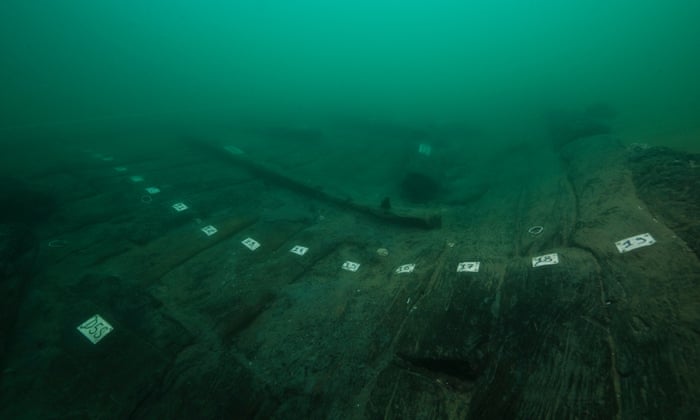

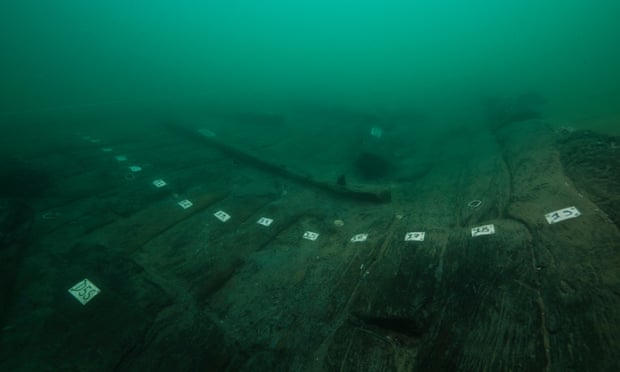


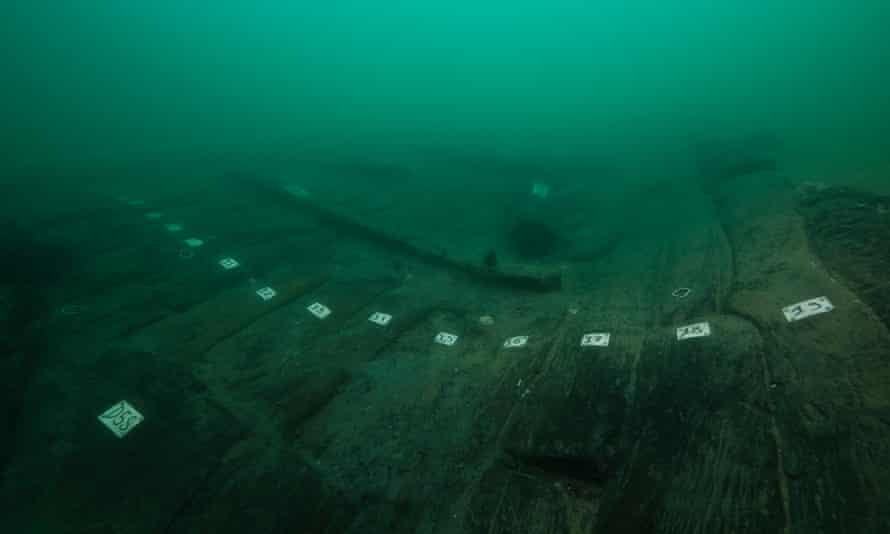

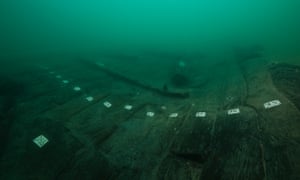
<figcaption class=„caption caption–img caption caption–img“ itemprop=„description“><svg width=„11“ height=„10“ viewbox=„0 0 11 10“ class=„inline-trianglesvg inline-iconsvg“><path fill-rule=„evenodd“ d=„M5.5 0L11 10H0z“/></svg> The wooden hull of ship 17. Photograph: Christoph Gerigk/Franck Goddio/Hilti Foundation </figcaption></figure><p>About 70% of the hull has survived, well-preserved in the Nile silts. Acacia planks were held together with long tenon-ribs – some almost 2m long – and fastened with pegs, creating lines of ‘internal ribs’ within the hull. It was steered using an axial rudder with two circular openings for the steering oar and a step for a mast towards the centre of the vessel.</p> <p>Robinson said: “Where planks are joined together to form the hull, they are usually joined by mortice and tenon joints which fasten one plank to the next. Here we have a completely unique form of construction, which is not seen anywhere else.”</p> <p>Alexander Belov, whose book on the wreck, <em><a href=„http://projects.arch.ox.ac.uk/OCMA-publications.html“ title=„“ data-link-name=„in body link“ class=„u-underline“>Ship 17: a Baris from Thonis-Heracleion</a></em>, is published this month, suggests that the wreck’s nautical architecture is so close to Herodotus’s description, it could have been made in the very shipyard that he visited. Word-by-word analysis of his text demonstrates that almost every detail corresponds “exactly to the evidence”.</p> <p>Ship 17 is the 17th of more than 70 vessels dating from the 8th to the 2nd century BC, discovered by <a href=„http://www.franckgoddio.org/“ data-link-name=„in body link“ class=„u-underline“>Franck Goddio</a> and a team – including Belov - from the European Institute for Underwater Archaeology during excavations in Aboukir bay, with which the Oxford Centre is involved.</p> <div class=„after-article js-after-article“/> <div class=„submeta “> Topics <div class=„submetasection-labels“> <ul class=„submetalinks“><li class=„submetalink-item“> <a class=„submetalink“ data-link-name=„article section“ href=„https://www.theguardian.com/science/archaeology“> Archaeology </a> </li> <li class=„submetalink-item“> <a class=„submetalink“ data-link-name=„“ href=„https://www.theguardian.com/observer“> The Observer </a> </li> </ul></div> <div class=„submetakeywords“> <ul class=„submetalinks“><li class=„submetalink-item“> <a class=„submetalink“ href=„https://www.theguardian.com/world/egypt“ data-link-name=„keyword: world/egypt“> Egypt </a> </li> <li class=„submetalink-item“> <a class=„submetalink“ href=„https://www.theguardian.com/tone/news“ data-link-name=„tone: news“> news </a> </li> </ul></div> <div data-component=„share“ class=„submetashare“> <ul class=„social social–bottom js-social–bottom u-unstyled u-cf“ data-component=„social“><li class=„socialitem socialitem–facebook “ data-link-name=„facebook“> <a class=„socialaction js-socialaction–bottom social-icon-wrapper“ data-link-name=„social bottom“ href=„https://www.facebook.com/dialog/share?app_id=180444840287&href=https%3A%2F%2Fwww.theguardian.com%2Fscience%2F2019%2Fmar%2F17%2Fnile-shipwreck-herodotus-archaeologists-thonis-heraclion%3FCMP%3Dshare_btn_fb“ target=„_blank“ title=„Facebook“> Share on Facebook <svg width=„32“ height=„32“ viewbox=„-2 -2 32 32“ class=„rounded-iconsvg centered-iconsvg social-iconsvg social-icon–facebooksvg inline-share-facebooksvg inline-iconsvg“><path d=„M17.9 14h-3v8H12v-8h-2v-2.9h2V8.7C12 6.8 13.1 5 16 5c1.2 0 2 .1 2 .1v3h-1.8c-1 0-1.2.5-1.2 1.3v1.8h3l-.1 2.8z“/></svg></a> </li> <li class=„socialitem socialitem–twitter “ data-link-name=„twitter“> <a class=„socialaction js-socialaction–bottom social-icon-wrapper“ data-link-name=„social bottom“ href=„https://twitter.com/intent/tweet?text=Nile%20shipwreck%20discovery%20proves%20Herodotus%20right%20%E2%80%93%20after%202%2C469%20years&url=https%3A%2F%2Fwww.theguardian.com%2Fscience%2F2019%2Fmar%2F17%2Fnile-shipwreck-herodotus-archaeologists-thonis-heraclion%3FCMP%3Dshare_btn_tw“ target=„_blank“ title=„Twitter“> Share on Twitter <svg width=„32“ height=„32“ viewbox=„-2 -2 32 32“ class=„rounded-iconsvg centered-iconsvg social-iconsvg social-icon–twittersvg inline-share-twittersvg inline-iconsvg“><path d=„M21.3 10.5v.5c0 4.7-3.5 10.1-9.9 10.1-2 0-3.8-.6-5.3-1.6.3 0 .6.1.8.1 1.6 0 3.1-.6 4.3-1.5-1.5 0-2.8-1-3.3-2.4.2 0 .4.1.7.1l.9-.1c-1.6-.3-2.8-1.8-2.8-3.5.5.3 1 .4 1.6.4-.9-.6-1.6-1.7-1.6-2.9 0-.6.2-1.3.5-1.8 1.7 2.1 4.3 3.6 7.2 3.7-.1-.3-.1-.5-.1-.8 0-2 1.6-3.5 3.5-3.5 1 0 1.9.4 2.5 1.1.8-.1 1.5-.4 2.2-.8-.3.8-.8 1.5-1.5 1.9.7-.1 1.4-.3 2-.5-.4.4-1 1-1.7 1.5z“/></svg></a> </li> <li class=„socialitem socialitem–email “ data-link-name=„email“> <a class=„socialaction js-socialaction–bottom social-icon-wrapper“ data-link-name=„social bottom“ href=„mailto:?subject=Nile%20shipwreck%20discovery%20proves%20Herodotus%20right%20–%20after%202%2C469%20years&body=https%3A%2F%2Fwww.theguardian.com%2Fscience%2F2019%2Fmar%2F17%2Fnile-shipwreck-herodotus-archaeologists-thonis-heraclion%3FCMP%3Dshare_btn_link“ target=„_blank“ title=„Email“> Share via Email <svg width=„32“ height=„32“ viewbox=„0 0 32 32“ class=„rounded-iconsvg centered-iconsvg social-iconsvg social-icon–emailsvg inline-share-emailsvg inline-iconsvg“><path d=„M23.363 20.875H8.637v-8.938l6.545 5.687h1.637l6.544-5.687v8.938zm-1.635-9.75L16 16l-5.728-4.875h11.456zM23.363 9.5H8.637L7 11.125v9.75L8.637 22.5h14.727L25 20.875v-9.75L23.363 9.5z“/></svg></a> </li> <li class=„socialitem socialitem–linkedin “ data-link-name=„linkedin“> <a class=„socialaction js-socialaction–bottom social-icon-wrapper“ data-link-name=„social bottom“ href=„http://www.linkedin.com/shareArticle?mini=true&title=Nile%20shipwreck%20discovery%20proves%20Herodotus%20right%20%E2%80%93%20after%202%2C469%20years&url=https%3A%2F%2Fwww.theguardian.com%2Fscience%2F2019%2Fmar%2F17%2Fnile-shipwreck-herodotus-archaeologists-thonis-heraclion“ target=„_blank“ title=„LinkedIn“> Share on LinkedIn <svg width=„30“ height=„30“ viewbox=„0 0 30 30“ class=„rounded-iconsvg centered-iconsvg social-iconsvg social-icon–linkedinsvg inline-share-linkedinsvg inline-iconsvg“><path d=„M10.576 7.985a1.57 1.57 0 0 1 0 3.137 1.568 1.568 0 0 1 0-3.137zm-1.353 4.327h2.706v8.704H9.223v-8.704zm4.403 0h2.595v1.19h.037c.361-.685 1.244-1.407 2.56-1.407 2.737 0 3.243 1.803 3.243 4.147v4.774h-2.702v-4.232c0-1.01-.02-2.308-1.406-2.308-1.408 0-1.623 1.1-1.623 2.235v4.305h-2.704v-8.704“/></svg></a> </li> <li class=„socialitem socialitem–pinterest “ data-link-name=„pinterest“> <a class=„socialaction js-socialaction–bottom social-icon-wrapper“ data-link-name=„social bottom“ href=„http://www.pinterest.com/pin/find/?url=https%3A%2F%2Fwww.theguardian.com%2Fscience%2F2019%2Fmar%2F17%2Fnile-shipwreck-herodotus-archaeologists-thonis-heraclion“ target=„_blank“ title=„Pinterest“> Share on Pinterest <svg viewbox=„0 0 32 32“ width=„32“ height=„32“ class=„rounded-iconsvg centered-iconsvg social-iconsvg social-icon–pinterestsvg inline-share-pinterestsvg inline-iconsvg“><path d=„M16.363 8C12.133 8 10 11.13 10 13.74c0 1.582.58 2.988 1.823 3.512.204.086.387.003.446-.23.04-.16.137-.568.18-.737.06-.23.037-.312-.127-.513-.36-.436-.588-1-.588-1.802 0-2.322 1.684-4.402 4.384-4.402 2.39 0 3.703 1.508 3.703 3.522 0 2.65-1.136 4.887-2.822 4.887-.93 0-1.628-.795-1.405-1.77.268-1.165.786-2.42.786-3.262 0-.752-.39-1.38-1.2-1.38-.952 0-1.716 1.017-1.716 2.38 0 .867.284 1.454.284 1.454l-1.146 5.006c-.34 1.487-.05 3.31-.026 3.493.014.108.15.134.21.05.09-.117 1.223-1.562 1.61-3.006.108-.41.625-2.526.625-2.526.31.61 1.215 1.145 2.176 1.145 2.862 0 4.804-2.693 4.804-6.298C22 10.54 19.763 8 16.363 8“/></svg></a> </li> <li class=„socialitem socialitem–whatsapp “ data-link-name=„whatsapp“> <a class=„socialaction js-socialaction–bottom social-icon-wrapper“ data-link-name=„social bottom“ href=„whatsapp:send?text=%22Nile%20shipwreck%20discovery%20proves%20Herodotus%20right%20–%20after%202%2C469%20years%22%20https%3A%2F%2Fwww.theguardian.com%2Fscience%2F2019%2Fmar%2F17%2Fnile-shipwreck-herodotus-archaeologists-thonis-heraclion%3FCMP%3Dshare_btn_wa“ target=„_blank“ title=„WhatsApp“> Share on WhatsApp <svg width=„30“ height=„30“ viewbox=„0 0 30 30“ class=„rounded-iconsvg centered-iconsvg social-iconsvg social-icon–whatsappsvg inline-share-whatsappsvg inline-iconsvg“><path d=„M22.09 7.87a9.9 9.9 0 0 0-7.05-2.92c-5.49 0-9.96 4.47-9.96 9.96 0 1.75.46 3.47 1.33 4.98L5 25.04l5.28-1.38c1.45.79 3.09 1.21 4.76 1.21 5.49 0 9.96-4.47 9.96-9.96a9.92 9.92 0 0 0-2.91-7.04m-7.05 15.32c-1.49 0-2.95-.4-4.22-1.15l-.3-.18-3.13.82.84-3.05-.2-.31a8.19 8.19 0 0 1-1.26-4.41c0-4.56 3.71-8.27 8.28-8.27 2.21 0 4.29.86 5.85 2.43a8.222 8.222 0 0 1 2.42 5.85c0 4.56-3.72 8.27-8.28 8.27m4.54-6.2c-.25-.12-1.47-.73-1.7-.81s-.39-.12-.56.12c-.17.25-.64.81-.79.97-.14.17-.29.19-.54.06-.25-.12-1.05-.39-2-1.23a7.283 7.283 0 0 1-1.38-1.72c-.15-.25-.02-.38.11-.51.11-.11.25-.29.37-.44.12-.15.17-.25.25-.42.08-.17.04-.31-.02-.44-.06-.12-.56-1.35-.77-1.85-.2-.49-.41-.42-.56-.43-.14-.01-.31-.01-.48-.01-.17 0-.44.06-.66.31-.22.25-.87.85-.87 2.08 0 1.22.89 2.41 1.02 2.57.12.17 1.75 2.68 4.25 3.76.59.26 1.06.41 1.42.52.6.19 1.14.16 1.57.1.48-.07 1.47-.6 1.68-1.18s.21-1.08.14-1.18c-.06-.08-.23-.14-.48-.27“/></svg></a> </li> <li class=„socialitem socialitem–messenger “ data-link-name=„messenger“> <a class=„socialaction js-socialaction–bottom social-icon-wrapper“ data-link-name=„social bottom“ href=„fb-messenger:share?link=https%3A%2F%2Fwww.theguardian.com%2Fscience%2F2019%2Fmar%2F17%2Fnile-shipwreck-herodotus-archaeologists-thonis-heraclion%3FCMP%3Dshare_btn_me&app_id=180444840287“ target=„_blank“ title=„Messenger“> Share on Messenger <svg width=„66“ height=„66“ viewbox=„-12 -12 90 90“ class=„rounded-iconsvg centered-iconsvg social-iconsvg social-icon–messengersvg inline-share-messengersvg inline-iconsvg“><path fill-rule=„evenodd“ clip-rule=„evenodd“ d=„M33 61.1c-3.6 0-7.1-.5-10.4-1.5L10.1 66V52.5C3.9 47 0 39.2 0 30.6 0 13.7 14.8 0 33 0s33 13.7 33 30.6c0 16.8-14.8 30.5-33 30.5zM36.5 41L28 32.2l-16.4 9 18-18.9 8.5 8.8 16.4-9-18 18.9z“/></svg></a> </li> </ul></div> <div class=„submetasyndication“> <ul class=„syndication–bottom u-unstyled“><li class=„syndicationitem“> <a class=„syndicationaction“ data-link-name=„meta-syndication-article“ href=„https://syndication.theguardian.com/automation/?url=https%3A%2F%2Fwww.theguardian.com%2Fscience%2F2019%2Fmar%2F17%2Fnile-shipwreck-herodotus-archaeologists-thonis-heraclion&type=article&internalpagecode=5891677“ target=„_blank“ title=„Reuse this content“> Reuse this content </a> </li> </ul></div> </div> </div> </div>
</div> </div> </html>
 Falls nicht anders bezeichnet, ist der Inhalt dieses Wikis unter der folgenden Lizenz veröffentlicht: CC Attribution-Noncommercial-Share Alike 4.0 International